Trailer Park Boys:Greasy Money
- 4.6
- Rating
- 5.00M
- Installs
- Free
- Price

 Analysis by App-foxy
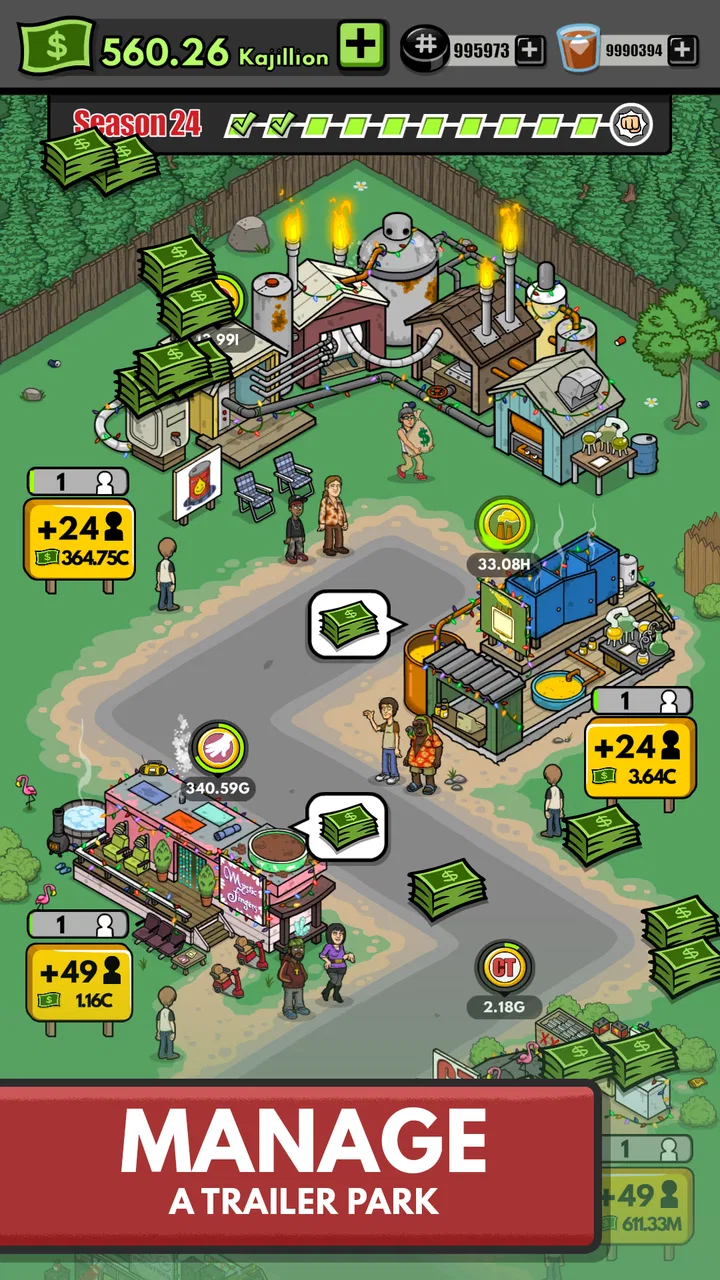
I spent time with Trailer Park Boys:Greasy Money expecting a simple tap-and-wait game, and that is exactly what it is—but the Trailer Park Boys setting gives the routine more personality than most idle simulators. The basic appeal is easy to understand: build up a small money-making operation, improve it, collect earnings, and keep the cycle moving while the game handles much of the background progress. I found it best suited to short visits throughout the day rather than long, uninterrupted sessions.
This is a free simulation game from East Side Games Studio, with a mature presentation aimed at adults familiar with the show’s rough humor and chaotic characters. It has reached over five million installs and holds a 4.6 average from around 350 thousand ratings, which suggests that the formula has found a sizeable audience. Those figures do not change the central question, though: is the game enjoyable for the way you personally use your phone, especially if the device is shared at home?
How the idle loop feels in everyday use
The most natural way I used it was in small gaps: checking in after breakfast, collecting progress during a break, and making a few upgrades before putting the phone away. It does not demand the kind of constant attention expected from an action game. Instead, the satisfaction comes from seeing a modest operation gradually become more productive and deciding where the next bit of progress should go.
You May Also Like

 Blood Strike: 2.5 Anniversary
Blood Strike’s Loadouts Turn Every Drop Into a Tactical Gamble
A close look at Blood Strike’s custom loadouts: how fast access to signature weapons reshapes its battle royale rhythm, rewards preparation, and narrows the gap between fights.

 Pandora - Music & Podcasts
Pandora’s Music Is Easy to Start, but Harder to Recover
Pandora’s strength is its low-effort path from a seed to a station. Its weak spot is how much confidence it asks you to place in connection, setup, and quiet recovery.

 8 Ball Pool
 Is Built on Rivalries, Rematches, and Routine
A close look at the rivalries, rematches, shared routines, and unanswered safety questions that turn a quick pool match into a persistent mobile community.

 Samsung Music
’s Quiet Strength Is Playing What You Already Own
Its reach comes less from spectacle than from dependable access to a personal library. That simplicity is both the app’s strongest retention engine and its ceiling.

 AccuWeather: Weather Radar
AccuWeather Review: A Quick, Clear Forecast for Everyday Decisions
For everyday plans, the best forecast is the one you can understand quickly. AccuWeather makes rain timing, radar, and local conditions easy to act on, with a few trade-offs.

 Hill Climb Racing
Why Hill Climb Racing Still Turns Crashes Into One More Run
A tiny car, a bumpy hill and one more upgrade: Hill Climb Racing keeps resurfacing because its simple chaos makes every near-miss feel personal.
More From Our News Desk



That makes it a reasonable choice for someone who likes management games but does not want to study complicated menus for an hour. The actions are familiar: tap to generate activity, improve parts of the operation, and return later to benefit from accumulated progress. The comedy and recognizable setting help make those repeated actions feel less anonymous than they would in a plain business simulator.
There is also a useful distinction between playing actively and simply checking in. When I had a few minutes, I could make several decisions and push the operation forward. When I was busy, I could leave it alone and come back later. That flexibility is the main reason I would recommend it to a friend who enjoys incremental progress but has an irregular schedule.
The trade-off is that the game’s rhythm can become predictable. If you want a story-heavy adventure, a competitive multiplayer match, or a simulation with detailed control over every worker and resource, this is not the strongest fit. Its pleasure is in repetition with gradual improvement, not in constant surprise or deep realism.
Why the setting matters more than it first appears
The Trailer Park Boys identity is not just decoration. It gives the upgrades and money-making loop a deliberately scruffy, mischievous tone. The setting makes the game feel like a comedy-themed idle simulator rather than a generic empire builder with new artwork pasted over it. I found that helpful during the slower stretches, when the underlying mechanics were repeating.
At the same time, the theme will not appeal equally to everyone in a household. Someone who enjoys clean, family-friendly management games may find the humor and mature atmosphere uncomfortable. This is not a neutral cartoon business game that I would hand to any child simply because the controls are easy.
What I would do during a normal check-in
My most effective routine was to collect available earnings first, then look at upgrades instead of spending immediately on whatever button was most visible. That small pause matters in idle games because an attractive short-term improvement may not be the best choice for keeping the whole operation moving. I paid attention to which improvement helped future collections and which one merely felt satisfying in the moment.
I also avoided opening the game repeatedly without a reason. A quick visit works better when I know what I want to accomplish: collect, improve one area, review the next target, and leave. This keeps the experience from turning into aimless tapping and makes it easier to fit around work, study, or household tasks.
For a shared device, that routine has another benefit. A person can finish a small, clearly defined session without leaving the game open for someone else to discover later. It is a simple habit, but it reduces confusion when several people use the same phone or tablet.
Shared devices, boundaries, and household coordination
On a family or household device, the first issue is not the idle mechanics. It is deciding who is actually playing and who is allowed to make purchases. Because progress and upgrades can be tempting to tap through quickly, I would not treat a shared device as an open playground for younger users. The mature age rating is an important part of that decision, not a minor label to ignore.
I would give the game its own agreed playing time and make the account boundary clear before anyone starts. If two people take turns on one device, they should know whether they are continuing one save or simply sharing access to the same game. Mixing expectations can cause arguments even when the game itself is easy to understand. One person may see an upgrade as obvious progress while another may have been saving for a different goal.
That is why I prefer a simple household rule: the person who begins the current session decides the spending plan, and no one else taps through purchases or upgrades without asking. This is especially useful when a child borrows an adult’s phone, because the game’s free entry does not mean every action inside it is free.
In-app purchases range from $0.99 to $199.99 per item. I would discuss that range openly before installing it on a shared device, particularly if payment details are already associated with the device. The sensible approach is to separate ordinary play from optional spending and to make sure every household member understands that tapping an attractive offer can have real financial consequences.
Keeping progress understandable between players
Idle games can create a quiet coordination problem: the game continues to feel personal even when the hardware is shared. I found it helpful to leave a short verbal note after playing, such as what had been upgraded and what the next intended goal was. That prevents the next person from assuming that every available improvement should be purchased immediately.
If several adults share the game, a rotating schedule can work better than constant handoffs. One person might check it in the morning and another in the evening, with both agreeing not to spend impulsively. The game does not need a complicated household system to support this; the useful structure comes from the players setting expectations themselves.
I would also avoid using the game as a background activity for a child while an adult is busy elsewhere. The simple controls make it easy to operate, but simplicity is not the same as suitability. A shared-device arrangement works best when an adult knows the game is being used, understands the mature context, and remains responsible for any account or purchase decisions.
Where account boundaries become especially important
If the device belongs to one person but several people use it, I would keep the game associated with the owner’s intended profile and avoid casual switching between unrelated players. Even without inventing special account tools, the practical lesson is clear: decide whose progress matters before investing time or money.
This matters most when a household member is only trying the game briefly. A visitor may tap through the opening progression and leave the owner with a changed setup. That is not a flaw unique to this title, but the idle format makes it easy to underestimate the effect of a few quick decisions. A little communication prevents more trouble than trying to reconstruct what happened afterward.
For my own use, I would keep the game on a personal device if I planned to spend regularly or cared strongly about the exact direction of the operation. On a shared device, I would treat it as a jointly managed pastime and keep purchases off-limits unless the owner is present.
Age, trust, and the mature tone
The mature 17+ rating should shape who gets access. The game’s connection to Trailer Park Boys means the humor and atmosphere are aimed at an adult audience, even though the underlying actions are easy to learn. I would not recommend it for a child just because it resembles a colorful tapping game.
For adults, the tone can be the main attraction. The rough, comedic presentation gives the familiar idle structure a distinct identity. For someone who has no interest in the show or its style of humor, that same identity may feel like noise around a fairly straightforward progression loop. I would suggest trying it only if the setting sounds appealing, rather than assuming the simulation label tells the whole story.
Trust also matters because the game is free to install but includes optional purchases. In a household, the responsible question is not merely whether someone can open the app. It is whether they understand what they are doing when they collect, upgrade, or respond to a paid offer. I would explain that clearly to any teenager using an adult’s device, and I would keep younger children away from it altogether because of the age context.
There is a difference between playing privately and introducing it during family time. I enjoyed the game more when I could follow its humor without needing to explain every reference or defend the tone to someone who did not choose it. As a shared household activity, it works best among adults who already know what kind of comedy they are getting.
Who should choose it—and who should skip it
I would recommend it to an adult who likes idle progression, recognizable comedy settings, and games that can be checked in short bursts. It is also a decent option for someone who wants a low-pressure simulation that does not require precise reflexes or a fixed daily schedule. The free entry makes it easy to see whether the loop and humor suit you before considering any optional spending.
I would skip it if you want a detailed economic sandbox, a calm family game, or a title with substantial control over every part of a business. I would also look elsewhere if repeated collection and upgrading feels like busywork to you. A more traditional strategy game will offer deeper planning, while a conventional story game will provide more direct narrative momentum.
Compared with other idle simulators, this one’s strongest advantage is its specific comedy world. Compared with management games that require constant optimization, its advantage is convenience. The weakness in both comparisons is depth: the easier it is to check in casually, the less demanding the decision-making tends to feel. I see that as a deliberate trade-off rather than a hidden problem, but it should guide your expectations.
Performance expectations and long-term value
The current version is 1.44.6, and the minimum operating system requirement is Android 7.0. That makes it accessible to a broad range of Android devices, although compatibility on paper does not guarantee that every older phone will feel equally comfortable during extended use. I would give an older device a short trial before deciding whether it belongs on a shared household phone.
Since the game is free, the real long-term question is whether the routine remains enjoyable without turning every session into a shopping decision. I found the best value came from treating purchases as optional rather than as part of the basic loop. The game is more satisfying when I focus on planning upgrades and watching progress accumulate, not on feeling pushed to accelerate every delay.
That approach also makes the title easier to recommend to friends. Someone can enjoy the comedy and incremental growth without committing money, while a player who wants to move faster can decide for themselves whether an optional purchase is worth it. I would still set a personal spending limit before experimenting, because the upper end of the listed purchase range is far beyond what I would consider casual entertainment spending.
Another practical point is attention. Idle games can encourage frequent checking, and that can be either convenient or distracting. I would turn the routine into a scheduled habit rather than letting it interrupt meals, work, or conversations. On a shared device, this is even more important: one person’s casual check-in should not become a reason for everyone else to wait for the phone.
My household verdict
After using it as both a personal idle game and something that could be passed around a household, I see Trailer Park Boys:Greasy Money as a focused adult time-filler rather than a universal family recommendation. Its strongest qualities are the recognizable comedic setting, easy check-in rhythm, and gradual sense of building something larger from small improvements.
The limitations are equally clear. The loop can feel repetitive, the mature rating rules out younger players, and the optional purchase range means a shared device needs sensible boundaries. It also does not replace a serious strategy game or a story-driven adventure. I would choose it when I wanted light management with a distinctive sense of humor, not when I wanted complex simulation.
For a single adult using a personal device, I think it is worth trying because the free entry lets the game prove itself through play. For a household, I would install it only after agreeing on age suitability, whose progress is being used, and who may approve spending. Those conversations are more important than any upgrade strategy.
My final recommendation is straightforward: choose it if short sessions, idle growth, and Trailer Park Boys’ mature comedy sound like a good match. Skip it if you need family-friendly content, deep economic control, or a game that constantly changes its demands. Used with clear boundaries, it is an easygoing simulation with enough personality to make the tapping routine enjoyable, but not enough depth to satisfy every kind of strategy player.
FAQs for Trailer Park Boys:Greasy Money
01What is Trailer Park Boys: Greasy Money?
Trailer Park Boys: Greasy Money is an idle management game based on the Canadian comedy series Trailer Park Boys. You manage Sunnyvale Trailer Park, collect cash from different businesses, upgrade characters and locations, and keep earning while you are away from the game. Its humor, familiar characters, and simple tap-and-upgrade gameplay make it especially appealing to fans of the show.
02How do you play Trailer Park Boys: Greasy Money?
The main objective is to generate as much money as possible by operating businesses around Sunnyvale. You tap to collect earnings, invest in upgrades, unlock new areas, and assign Trailer Park Boys characters to improve production. The game also includes automated income, so progress continues when you are not actively playing. Regularly checking in helps maximize rewards and speed up development.
03Is Trailer Park Boys: Greasy Money free to download?
Trailer Park Boys: Greasy Money is generally available as a free-to-download mobile game, allowing players to begin without paying upfront. However, it includes optional in-app purchases that can provide premium currency, boosts, or faster progression. You can play without spending money, although progress may feel slower and some special upgrades or event rewards may require additional time.
04Does Trailer Park Boys: Greasy Money require an internet connection?
An internet connection is normally recommended, and some features may require you to be online. Connectivity can be needed to synchronize progress, access events, receive updates, view advertisements for bonuses, and process in-app purchases. While certain parts of the idle gameplay may appear to work temporarily offline, keeping a stable connection is the safest way to avoid missing rewards or synchronization issues.
05Is Trailer Park Boys: Greasy Money suitable for children?
The game is primarily designed for fans of Trailer Park Boys, a comedy series known for adult humor, strong language, alcohol-related themes, and questionable behavior. Although the gameplay is simple and accessible, its characters and dialogue reflect that mature tone. Parents should review the store rating, advertising content, and purchase settings before allowing younger players to download and use the app.
Pros
- Easy-to-learn idle gameplay suited to short play sessions.
- Features familiar characters and humor from the TV series.
- Offline progress lets businesses keep earning while you are away.
- Frequent events provide extra rewards and temporary objectives.
- Many businesses and characters offer plenty of content to unlock.
Cons
- Progress can become heavily dependent on waiting or watching ads.
- In-app purchases may be needed to advance faster.
- The screen can feel crowded with notifications and upgrade prompts.
- Some upgrades require significant grinding after the early stages.
- A stable internet connection may be needed for events and cloud features.

Trailer Park Boys:Greasy Money
Gallery